
By Doug Pettay
RitaSue Siegel is right: New York City has a serious and growing problem with the competition for limited curb space. But if we want to understand why an eleven minute drive takes forty minutes, we need to distinguish between loss of parking spaces and causes of traffic congestion.
Empire Bins will occupy some curbside parking spaces. That is a legitimate concern, particularly in Manhattan, where curb space is extraordinarily valuable. But the available evidence does not support treating Empire Bins as a primary cause of New York City’s traffic congestion. In fact, the city’s own current environmental analysis estimates that the complete containerization program will require approximately 29,842 parking spaces citywide, or about 1.52% of available curbside parking. Manhattan would experience the greatest proportional effect, with an estimated 10,102 spaces—about 6.42% of available curbside parking.
That impacts private vehicle parking. It is not, however, the same thing as removing travel lanes. Empire Bins are generally located in the parking lane. Their effect on traffic is therefore primarily indirect: fewer parking spaces can increase competition for the curb and potentially encourage more cruising, illegal stopping and double parking. These fewer parking spaces would not generate enough additional passenger vehicle trips (PCEs) to meaningfully impact traffic.
The bigger issues: the number of cars on the road and blocked travel lanes
The most dramatic change in New York’s street environment has been the enormous growth of the for-hire vehicle fleet with the arrival of Uber and Lyft.
TLC data show:
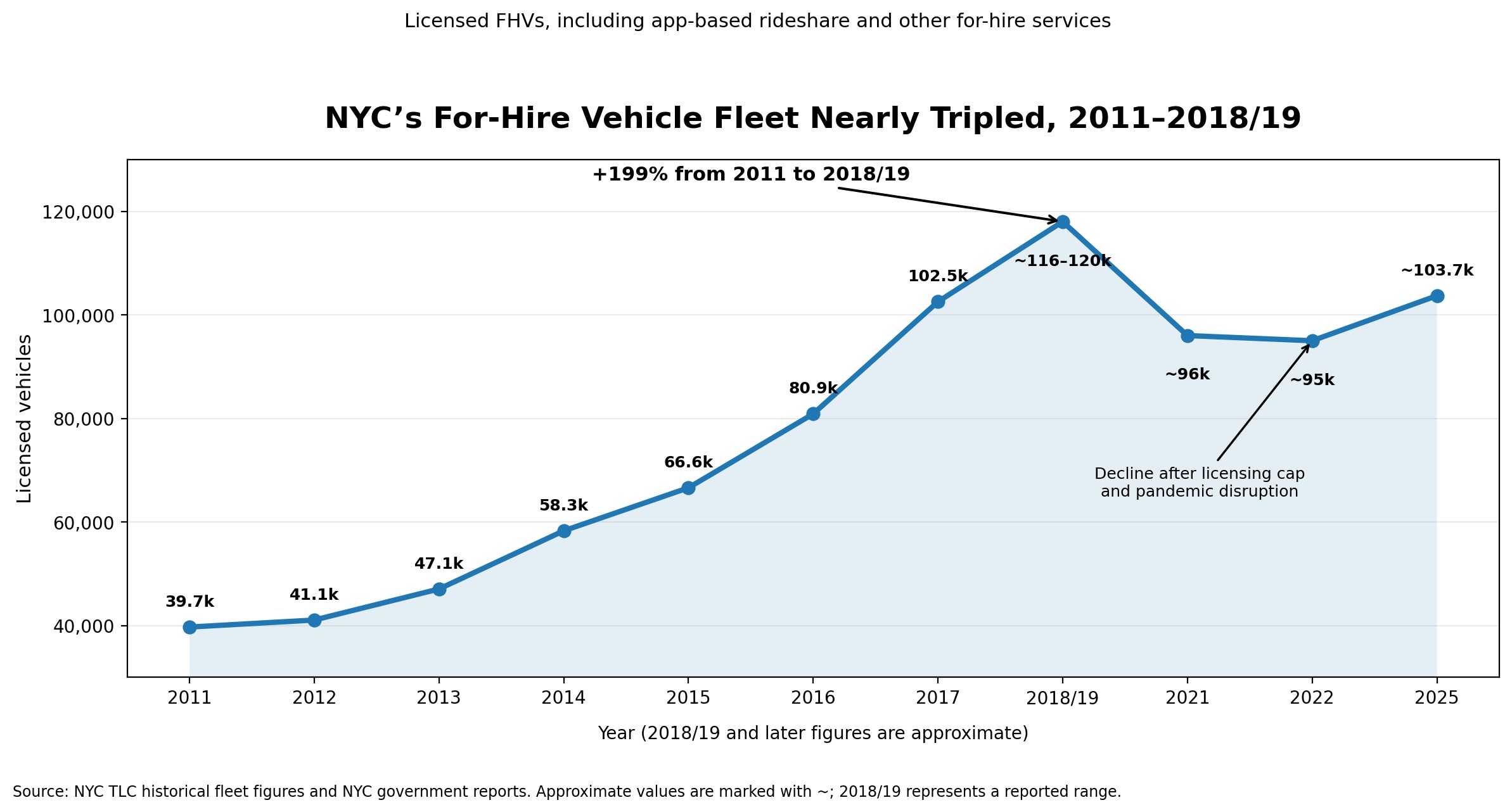
The early growth is especially striking. Licensed FHVs increased from 39,708 in 2011 to 102,536 in 2017—an increase of approximately 62,800 vehicles, or 158%. By 2019, the overall FHV fleet peaked at approximately 120,000 vehicles. The current fleet remains enormous. TLC’s 2025 Annual Report reports approximately 103,700 licensed FHVs, in addition to 13,589 yellow taxis.
The scale of the change is unmistakable: the FHV fleet more than doubled with the expansion of app-based ride-hailing.
Why do these vehicles matter to congestion?
It isn’t simply the number of Uber and Lyft cars.
A ride-hail vehicle can occupy valuable street space when it is:
- carrying a passenger;
- cruising while waiting for its next passenger;
- double parked at pick-up and drop-off
- blocking a bus or bicycle lane;
A 2019 TLC and DOT analysis specifically described “cruising” of empty ride-hail vehicles in the congested Manhattan core as a source of additional congestion as the cars are either circulating as they wait for the next fare or often double-parked.
Why are so many vehicles double parked?
Double parking is often treated as a problem of individual driver behavior. That is only part of the story.
In New York, double parking is frequently a predictable consequence of insufficient curb space for the number of things that the curb is expected to accommodate.
The curb is simultaneously being asked to provide space for:
- privately owned vehicles;
- commercial deliveries;
- restaurant deliveries;
- Amazon and other package deliveries;
- Construction and maintenance vehicles;
- garbage collection;
- taxis / Uber / Lyft pickups and drop-offs;
- Access-A-Ride;
- School buses
- moving trucks;
- bike infrastructure;
- buses
- bike lanes and Citi Bike;
- outdoor dining; and
- pedestrian space.
When all of those demands compete for the same limited curb, some drivers stop illegally in the travel lane because they have nowhere else to go.
NYC DOT explicitly recognizes this relationship. Its loading-zone program states that double parking and blocked bike and bus lanes contribute to congestion and that dedicated loading zones can reduce double parking by up to 70 percent at locations where they are installed.
DOT has also identified commercial loading as a major contributor. In one earlier study, at least one travel lane was blocked by a double-parked vehicle for approximately one-quarter of the day in the study area.
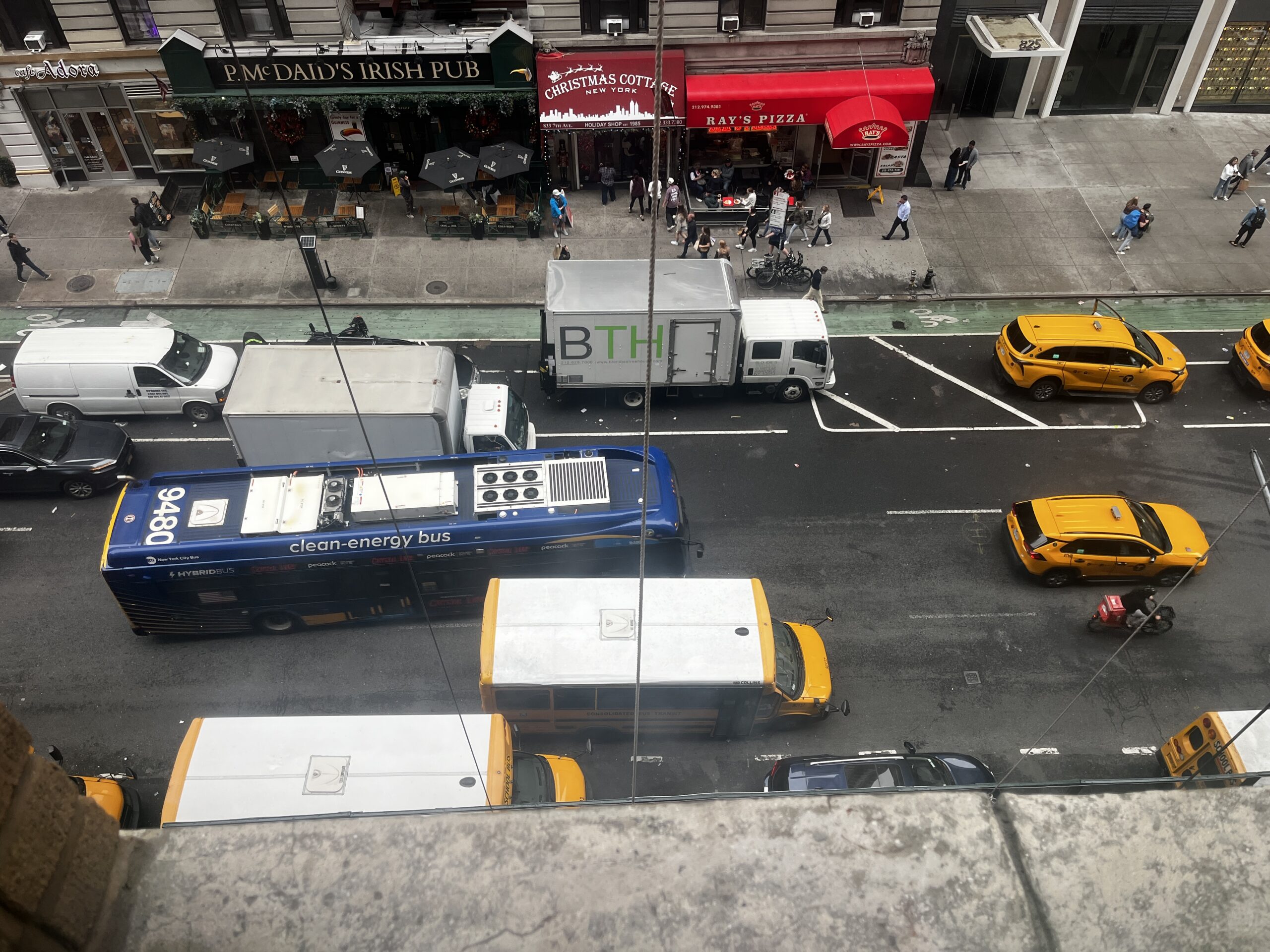
And the problem is getting bigger because deliveries are getting bigger.
According to the NYC Comptroller, daily package deliveries increased from approximately 1.1 million in 2017 to more than 1.8 million in 2019 and approximately 2.5 million per day in 2024.
That is a huge increase in the number of vehicles that need to reach buildings, find curb space, unload packages and leave.
DOT now explicitly describes daytime truck deliveries as contributing to both congestion and double parking and is trying to shift 62,000 daily truck deliveries to off-hours by 2040.
The traffic problem is therefore bigger than Empire Bins
New York’s congestion has multiple interacting causes:
- Ride-hail vehicles. The FHV fleet expanded dramatically after the introduction of app-based dispatch, and empty cruising, pickups, drop-offs and illegal stopping consume roadway and curb capacity.
- Commercial and package deliveries. E-commerce has dramatically increased the number of delivery vehicles circulating in neighborhoods. NYC now receives millions of packages every day.
- Double parking and illegal stopping. Vehicles stopped in a travel lanes can reduce a three-lane avenue to one usable lane or bring an entire street to a stand still. That creates disproportionate congestion because traffic capacity collapses at bottlenecks.
- Construction and street closures. NYC DOT routinely identifies construction projects, street events and emergency closures as disruptions to normal traffic flow.
- Traffic entering Manhattan. The enormous concentration of jobs, tourism, commercial activity and regional travel creates extraordinary demand for the limited amount of street space in Manhattan.
- Insufficient availability of parking spaces. New York City’s shortage of available parking spaces forces drivers to circle blocks searching for parking, adding unnecessary traffic, wasting time, and encouraging double parking when no legal space is available. Keeping street parking free in residential areas and, in commercial zones, at prices below market rates leaves curb spaces perpetually occupied, making them unavailable when drivers need them for short trips.
- Declining transit performance can create a vicious cycle. When buses become slower and less reliable, some travelers shift to cars and for-hire vehicles, adding still more vehicles to the street. NYC DOT has specifically identified declining bus speeds and increasing for-hire vehicle use as transportation concerns.
The curb is effectively New York City’s loading dock, taxi stand, parking lot, bus stop, pickup zone, bicycle facility and garbage staging area—all at the same time.
What New York should actually be doing
If we want to make taxi rides faster, move buses efficiently, keep the bike lanes clear, reduce honking, and decrease air pollution:
The city needs to:
- Aggressively enforce double parking, particularly on major avenues and at known bottlenecks.
- Expand dedicated loading zones where delivery activity is predictable.
- Create designated Uber/Lyft/taxi pickup and drop-off locations in high-demand areas. Paint them purple so everybody knows.
- Enforce bus-lane and bike-lane violations.
- Shift more commercial deliveries to overnight and off-peak hours.
- Price and manage street parking according to demand by implementing EasyPark.
- Publish block-by-block data showing where parking spaces are removed, where double parking occurs, and how travel speeds change.
New York has already begun some of this work. Since December 2021, DOT says it has installed nearly 3,000 loading zones, including more than 500 locations specifically identified through public reports of double parking and blocked bike and bus lanes.
That is the direction the city should continue.
The larger lesson
The West 50s Neighborhood Association is right to ask whether removing thousands of curb spaces will have unintended consequences.
But blaming the future traffic problems primarily on Empire Bins risks focusing on the newest object on the street rather than the underlying problem.
New York has experienced a remarkable transformation in how its streets are used. We have dramatically more ride-hail vehicles than we had before Uber and Lyft, millions more package deliveries, growing demand for passenger pickups and drop-offs, increasing competition for curb space, and a transportation system in which a single illegally stopped vehicle can seriously disrupt traffic.
The Empire Bin program should therefore be evaluated not in isolation but as part of a comprehensive curb-management strategy.
If the city takes away a parking space for a garbage container, it should know what that space is worth.
If it removes a parking space and creates a loading zone somewhere else, it should measure whether double parking decreases.
If an Uber stops in a travel lane because there is nowhere legal to pick up a passenger, that is a curb-management failure—not simply a bad driver.
And if a delivery truck blocks an avenue because there is no loading space, the city should address the underlying shortage rather than merely ticket the driver.
New York’s streets are a finite resource. The solution is not to pretend that there is enough space for everything. The solution is to manage that limited space much more intelligently.
Where would you advocate for change on your street? Let us know and let’s see how we can make a difference.
Doug Pettay is a landscape architect and a neighbor on West 54th Street.